Ontario businesses with 5 to 19 employees went from first to last on AI use
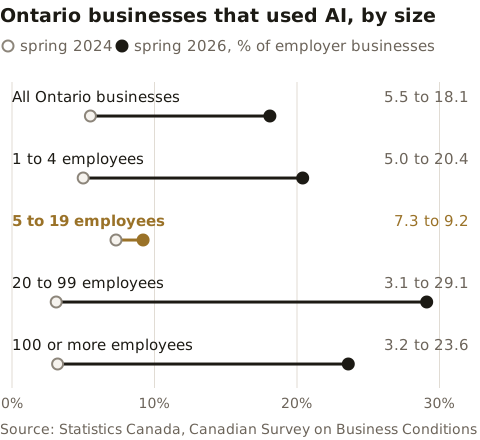
Small business AI adoption by size, from Statistics Canada: Ontario firms with 5 to 19 employees led on AI use in 2024 and came last in 2026, at 9.2%.
Published: 2026-10-22 · Author: Ahmed Heshmat · 5 min read
In spring 2024, 5.5% of Ontario employer businesses said they had used AI to produce goods or deliver services. By spring 2026 it was 18.1%, according to Statistics Canada's Canadian Survey on Business Conditions, and every size class at least tripled except one. Businesses with 5 to 19 employees (on payroll, owners not counted) went from 7.3% to 9.2%. Two years ago they were the likeliest of any size in the province to use AI, and this spring they were the least likely.
We read that middle band as the point where a business stops being an owner and a couple of helpers and starts running on systems that nobody owns yet: a plumbing company with a dispatcher, a brokerage with a front desk, a small accounting or law office. In a business that size, AI for a small business mostly means getting the phone, the inbox and the job software already in use to work together.
Ontario's middle band went from first to last
Across Canada the four size classes sat within a point of each other in 2024. In Ontario the 5 to 19 band started ahead, and by spring 2025 it was already last, at 10.3%, so this spring's figure is not one bad reading. Nationally the band trails as well, at 14.9%, though by much less.
Statistics Canada grades this spring's Ontario figure for the band A, its most precise. We do not know why the band sits so much lower in Ontario than nationally, and the survey does not say.
These are also the last of these numbers for a while. The quarterly survey ended with its summer 2026 round, and its replacement, the Survey on Technology Use by Businesses, began collecting on October 20. Statistics Canada expects its first AI figures in 2027.
The band plans AI least, and its plans ran ahead of use
Asked in July and August whether they planned to use AI in the next 12 months, 17.2% of Ontario businesses with 5 to 19 employees said yes, against 26.0% of those with 1 to 4.
Plans come from a different sample, a quarter later, and for this band they have run ahead of use. In summer 2025, 18.5% of Ontario businesses with 5 to 19 employees said they planned to use AI; the next spring, half that share said they had. Nationally, use has come in above plans, so the shortfall is particular to Ontario's band, and it is why the questions below ask for counts.
Four in ten say AI is not relevant to them
In the spring, Statistics Canada asked every business what limits its use of AI. Among businesses with 5 to 19 employees across Canada, 41.0% answered that AI was not relevant to the business. Cost came up for 9.8%, fewer than named privacy or security.
The survey asks whether the business used AI "in producing goods or delivering services", and the only examples on the form are machine learning, virtual agents and voice recognition. An owner who runs a renovation crew hears that as AI doing the renovation, and the honest answer is no.
In our experience the work where AI pays in a business that size sits around the service: answering the phone when everyone is on a job, writing a request down once instead of three times, chasing the quote and the invoice. At a GTA plumbing company we work with, work orders arrived by email and stayed there, and the schedule lived in the owner's head. Nobody there called that an AI question. The first thing we built for them reads those emails into a job list. Our explanation for the lag comes from work like this; the survey does not test it.
Five questions before you decide AI is not relevant
Answer these for one ordinary week. Each answer should be a number or a name.
- Who answers the phone when everyone is busy, and what happens to the call? If the answer is voicemail that someone clears at night, count how many calls went there.
- How many times is a new request written down before the work starts? Count the retyping: from a text into a notebook, from the notebook into the job software, from there into an invoice.
- How long does a customer wait for a quote, a callback or an invoice? Pick one and time the last ten.
- Which questions do customers ask every week that one page could answer? Hours, prices, what to bring, whether you serve their area.
- Who would own a new tool, and how many hours a week can they give it? If nobody, that comes before any software.
A bad number on any of the first three is usually work AI can take on in a business your size. If two or more came back vague, spend a month counting before you buy anything, and read where small business AI projects break before you talk to a consultant.
How we read the tables
Use figures come from Statistics Canada tables 33-10-0825-01, 33-10-1004-01 and 33-10-1167-01, the spring rounds of the Canadian Survey on Business Conditions in 2024, 2025 and 2026. The 2026 round was collected April 1 to May 6. Plans come from tables 33-10-1045-01 and 33-10-1207-01 (summer 2025 and 2026) and barriers from 33-10-1169-01. The survey covers employer businesses: "1 to 4 employees" means 1 to 4 people on payroll, owners not counted, and businesses with no employees are not in it. Every figure is a share of businesses, not of jobs or sales. Statistics Canada grades every estimate by its precision, and each figure quoted here is graded A, B or C. The figures behind the chart, with their grades, are in a CSV, and Statistics Canada's own analysis of the national results is on its site.