AI receptionist cost per call: 867 answered calls, itemised from the bill
AI receptionist cost per call, from the platform's own bill: 867 answered calls at 27 cents on average. The model was a fifth of it.
Published: 2026-09-26 · Author: Ahmed Heshmat · 7 min read
Key takeaways
- The AI receptionist cost per call on the property management line we run came to 31 cents on average, 29 cents at the median, over 509 answered calls between 31 August and 26 September 2026. The brokerage line at the same operation averaged 22 cents over 358 calls. Both figures are the voice platform's own billing records, in US dollars.
- Call length is nearly the whole bill. Every line item but one is charged by the second, so a call that ended after ten seconds cost about five cents, and the longest call of the four weeks, seven and a half minutes, cost $1.53.
- GPT-4.1, the model doing the talking, was a fifth of the bill. The line we actually control is the length of the agent's instructions: past 4,000 tokens the platform adds a surcharge, and on the property management line it came to 17% of the total.
- Nothing on the bill measures whether the agent handled the call well. That depends on the emergency list it follows and on whoever edits it.
Where the numbers come from
Both lines belong to one Toronto property management and brokerage operation, and both are answered by voice agents we built and run. The agents sit on Retell, a voice agent platform. When a call ends, Retell sends a record of it to the workflow that routes the call to the right person, and that record carries the call's cost, split into every product that went into it, down to a fraction of a cent.
The workflow keeps about four weeks of those records, which sets the window: 867 calls and 1,061 minutes across both lines, for $234.59 in platform charges. We kept the durations and the cost lines and dropped every name, number and transcript on the way out.
What a minute costs
A minute on the property management line cost 22.5 cents, and this is where it went:
| Line on the bill | Cents a minute | What it pays for |
|---|---|---|
| Retell voice engine | 5.5 | the platform running the call |
| GPT-4.1 | 4.5 | the model deciding what to say |
| ElevenLabs voice | 4.0 | the voice the caller hears |
| Long-prompt surcharge | 3.8 | extra model charge for long instructions |
| Phone line, Twilio Canada | 3.0 | the number the calls ring through |
| Flat charge per call | 1.1 | 1.5 cents on every call whatever its length, spread per minute |
| Knowledge base | 0.5 | the agent searching the documents it was given |
The brokerage line ran at 21.4 cents a minute. Its agent carries shorter instructions, so it paid less surcharge, and its calls were shorter: 54 seconds at the median, against 77 on the property management line.
Length is the bill
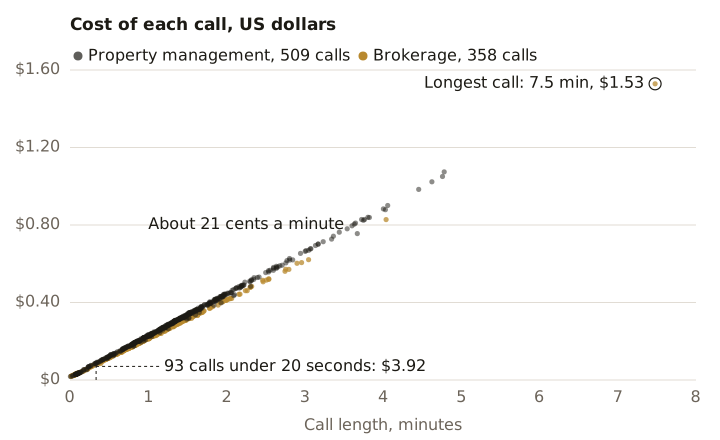
Plot every call by length and cost and you get a straight band, rising about 21 cents a minute from under two cents for a call that connected and dropped. Length alone explains 99.6% of the variation in what a call cost.
The bottom of the band matters more than it looks. 93 of the 867 calls, 10.7%, lasted under 20 seconds, and in 88 of them it was the caller who hung up. All 93 together cost $3.92.
That is worth knowing before you read a pricing page. Smith.ai's AI receptionist, one published example of per-call pricing, works out at $1.67 to $2.00 a call on its paid plans. Its pricing page says known spam numbers are filtered before they count, and that up to 10% of a month's calls can be struck as spam. A per-call price pays for things a platform bill leaves out, so the gap between the two is not all margin. What matters for a buyer is the shape of the price: if your line takes a lot of short calls, a per-minute price follows the cost, and a per-call price charges a ten-second hang-up the same as a four-minute call about a leak.
The model is a fifth of the bill
GPT-4.1 cost 4.5 cents a minute, 20% of the property management bill. Retell lists GPT-4.1 mini at 1.28 cents, so a smaller model would take about three cents off a minute. On a line that takes emergency calls we would test a smaller model against the full emergency list before we let it answer anything, and we have not run that test.
The surcharge is the more interesting line. Retell's billing rules scale up the model charge when an agent's prompt runs past 4,000 tokens. The prompt here is the agent's instructions plus the conversation so far, and it is sent again every time the agent answers, about nine times on a typical call. The property management agent ran at about 7,300 tokens a turn and paid 3.8 cents a minute for it. The brokerage agent, at about 6,000, paid 2.3 cents.
Most of those tokens are rules: what counts as an emergency, who gets paged for what, what to say when a caller asks for a person. They tend to grow, because the usual fix for a bad call is another rule. On the morning of 1 September the property management agent's instructions were revised: calls at 9:26 ran on version 42 and calls from 10:03 on version 57. The prompt grew from about 6,100 tokens a turn to about 7,300, and the surcharge went from 2.5 cents a minute to 3.8.
We could cut the instructions back under 4,000 tokens and save most of the surcharge. We would rather pay it than drop a rule. The rules that line runs are in the after-hours triage rules, and what happened on the calls where a rule was missing is in what our voice agents got wrong.
The line that did not match the pricing page
Four of the per-minute lines on the bill match Retell's published prices exactly: the voice engine, the model, the voice and the knowledge base. The phone line does not. Retell's pricing page lists Canadian telephony through Twilio at 1.5 cents a minute, and every call on both lines was billed at 3 cents. That is 13% of the property management bill. We noticed it writing this post. One more item is not on the pricing page at all: the flat 1.5 cents a call, billed under a GPT-4.1 text line.
Neither moves the total much, but both are reasons to ask for the itemised bill rather than the rate card.
What the bill leaves out
The per-call cost covers the call. It does not cover the office phone system the calls forward from, the workflow that pages the on-call phone and posts each call to the team, the grader that reads every call afterwards, or the hours spent reading those reports and changing the instructions. Those decide whether a tenant with water coming through a ceiling gets a person tonight, and none of them show up in 29 cents.
That part is the work we are paid for, a setup fee and then a flat monthly fee to operate. The running costs in this post are quoted separately, before anything is signed. What the build and the operation include is on our property management answering service page.
If you are comparing vendors, four questions get past the headline price:
- What does a minute cost, and which model, voice and phone line are in it?
- How are calls under 20 seconds billed?
- How long are the agent's instructions, and who changes them after a bad call?
- Can you see the itemised bill for your own calls?
Method
The source is the end-of-call record Retell sends for every call, as received by the operation's routing workflow, from 31 August 12:30 to 26 September 12:13, Toronto time. One record per call: 509 on the property management line and 358 on the brokerage line. Costs are Retell's combined cost for each call, in US dollars. Per-minute figures divide a line's total cost by its total minutes, and the token counts are the prompt sizes Retell reports for each model request.
Not in these figures: the office phone system, the workflow and its hosting, Slack, and anyone's time. One operation, one platform, four weeks. Retell's list prices are from its pricing page and its surcharge rule from its billing exceptions, both read on 26 September 2026, as was Smith.ai's AI receptionist pricing.
The agents themselves, and what we build around them, are on our AI voice agents page.