Work order completion time: the jobs that wait on an owner
Work order completion time across 2,363 repairs at a Toronto property manager: a median 14.9 days when the owner had to approve, 5.8 when not.
Published: 2026-10-07 · Author: Ahmed Heshmat · 6 min read
Key takeaways
- Work order completion time at one Toronto property management and brokerage operation was a median 14.9 days for repairs that needed the owner's approval and 5.8 days for repairs that did not, across 2,363 completed jobs opened between September 2025 and August 2026.
- Two thirds of those repairs, 1,566, needed an owner's yes. Of the approval jobs that carried a cost estimate, 804 of 806 were estimated under $2,000.
- Some of the gap is just bigger jobs needing approval. Compared like for like it shrinks without closing: within each trade the approval jobs ran 2.9 to 12.7 days slower at the median, and among jobs estimated under $2,000 it was 13.7 days against 9.5.
- The record shows that a job needed approval. It does not show when the owner was asked or when they answered, so it cannot tell you how much of the wait was the owner. That is the first thing we would fix.
Where the numbers come from
The operation runs its maintenance desk in LeadSimple. We work inside it, and our voice agents answer its phones. Every repair is a LeadSimple process with an opening date, a closing date and a yes or no field for whether it needs the landlord's approval. The field says landlord. In this post that is the owner, the client who hired the property manager.
We took every repair opened from 1 September 2025 to 30 August 2026 and kept the ones that were completed and had the approval field filled in. Completion time runs from the request being opened to the repair being closed, so it includes the visit, any trip back for parts, and the close-out. We kept counts and durations and left every address, name and description behind.
What the approval flag does to the clock
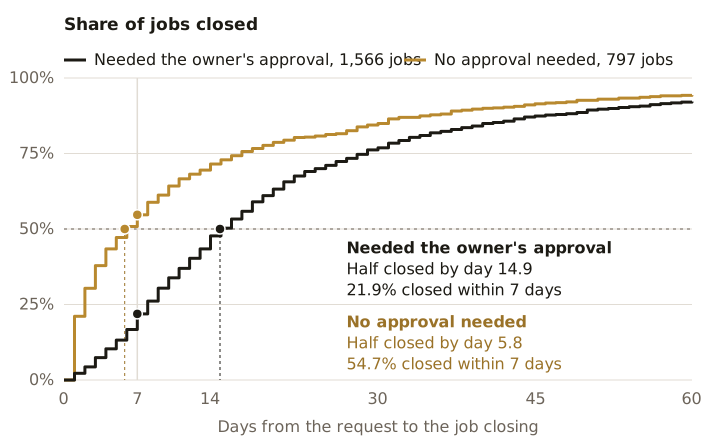
Repairs that did not need approval moved early. 30.4% were closed within two days and more than half within a week. Repairs that needed approval almost never closed quickly: 4.3% inside two days, and half were still open on day 14.
Both groups have a long tail, and the approval tail is longer. 362 approval jobs took more than 30 days, 23.1% of them, against 15.1% of the rest. Between them, the approval jobs account for 75.7% of all the days those repairs spent open.
For an outside reference, RL Property Management in Columbus, Ohio publishes its median repair days on a live scorecard: 6, as of July 2026. We do not know how it counts a repair day, so read that as a reference point rather than a match. The jobs here that needed no approval land right beside it, and the jobs that needed approval at two and a half times it.
These are completed jobs only. When the data was pulled, 117 approval jobs were still open against 39 without approval, so the chart, if anything, flatters the approval side.
Bigger jobs, or the wait?
The fair objection is that approval jobs are bigger. A new fridge needs an owner's yes and a sticking lock does not, and the fridge takes longer whoever signs for it. That accounts for some of the gap. It does not account for all of it, because the gap survives inside every trade:
| Trade, as the operation files it | Needed approval | Median days | No approval | Median days |
|---|---|---|---|---|
| General handyman and other | 548 | 13.9 | 449 | 4.8 |
| Plumbing | 352 | 14.0 | 102 | 7.6 |
| Appliance | 189 | 17.6 | 44 | 11.9 |
| Locks and doors | 142 | 13.4 | 47 | 2.7 |
| HVAC | 96 | 12.4 | 45 | 9.5 |
| Pest control | 32 | 15.4 | 43 | 2.7 |
HVAC had the smallest gap. Locks and doors had one of the largest, which is uncomfortable, because a door repair with no approval needed closed in under three days at the median and the same kind of job with approval took close to two weeks.
The cost field gives a second like-for-like cut. It only records whether the estimate was under or over $2,000, and almost every estimated job was under. Within that band, approval jobs took a median 13.7 days and the rest 9.5. So the honest version of the headline is about four days on a comparable job, and more in some trades, rather than nine days across the board.
What the record cannot tell you
We cannot split those days into time spent waiting for the owner and everything else. The record shows that a job needed approval. Nothing in it says when the quote went to the owner, how it went, or when they said yes. A slow owner and a slow trade look the same from here.
That matters because the fix depends on which one it is. If owners answer within the hour and the trade takes a week to come back with parts, chasing owners changes nothing. If the quote sits in an inbox for five days, nothing else you do will move the number.
What we would change first
Put a time on the ask and the answer. Two dated entries on every approval job, one when the quote goes to the owner and one when they reply, turn a yes or no field into a measurement. A month of them shows whether the wait is the owner. If you want to read those entries back out of LeadSimple rather than off a screen, what its API exposes, and what it quietly ignores is worth reading first.
Check what your limit is catching. The owner's spending limit sits in each management agreement, and this record does not show it. What it does show is that two thirds of flagged repairs needed a yes, and nearly every one of those was estimated under $2,000. When the limit sits below most of the work, most jobs wait on a reply. A higher standing limit for named categories, locks and pest treatment first, is easier to agree once at renewal than job by job.
None of this pauses the landlord's duty. Section 20 of Ontario's Residential Tenancies Act makes the landlord responsible for keeping a unit in a good state of repair, and a limit only decides who signs off on the money. Emergencies should never wait in this queue at all; the rules our after-hours agent uses to tell them apart are in our maintenance triage rules.
Make the yes easy to give, and chase it. An owner who gets a quote by email answers when they next open email. A text with the trade's photos, the price and a reply that counts as approval gets answered from a phone, and a reminder at a set hour does the chasing nobody on the desk has time for. That is a small build on top of a desk the operation already runs, the kind of work on our LeadSimple automation page. We have not built it for this operation yet, and with the two timestamps in place a month would tell us whether it is worth building.
Reading your own repair records this way is part of our AI readiness audit for property management.
Method
Source: the operation's LeadSimple repair processes as exported on 30 August 2026. We started at 1 September 2025 because the 1,518 processes created on 1 August 2025 were loaded as one batch, most of them opened and closed within the same second, and we left the rest of August 2025 out with them. Of the 4,908 repairs opened in the window, 3,833 were completed, 827 cancelled and 248 still open. We analysed the 2,363 completed repairs with the approval field filled in. Another 1,470 completed repairs had it blank and are left out; their median was 4.8 days.
Completion time is the closing timestamp minus the opening timestamp, in days. We report medians because a few repairs ran for months, which pulls the averages up to 23.3 days for approval jobs and 14.7 for the rest. Trades are the operation's own categories, shown only where each side had at least 25 jobs. The cost band is the estimate recorded on the job, not the final invoice. Nothing here measures how long a trade took on site.
What we build for property management desks, from the phone line to the ledger, is on our property management page.